How to get over fear of public speaking
How to get over fear of public speaking comes down to practice, not willpower: rehearse out loud several times over a few days, breathe out slowly before you start, and speak in small, low-stakes rooms first so the fear gets smaller with every talk.
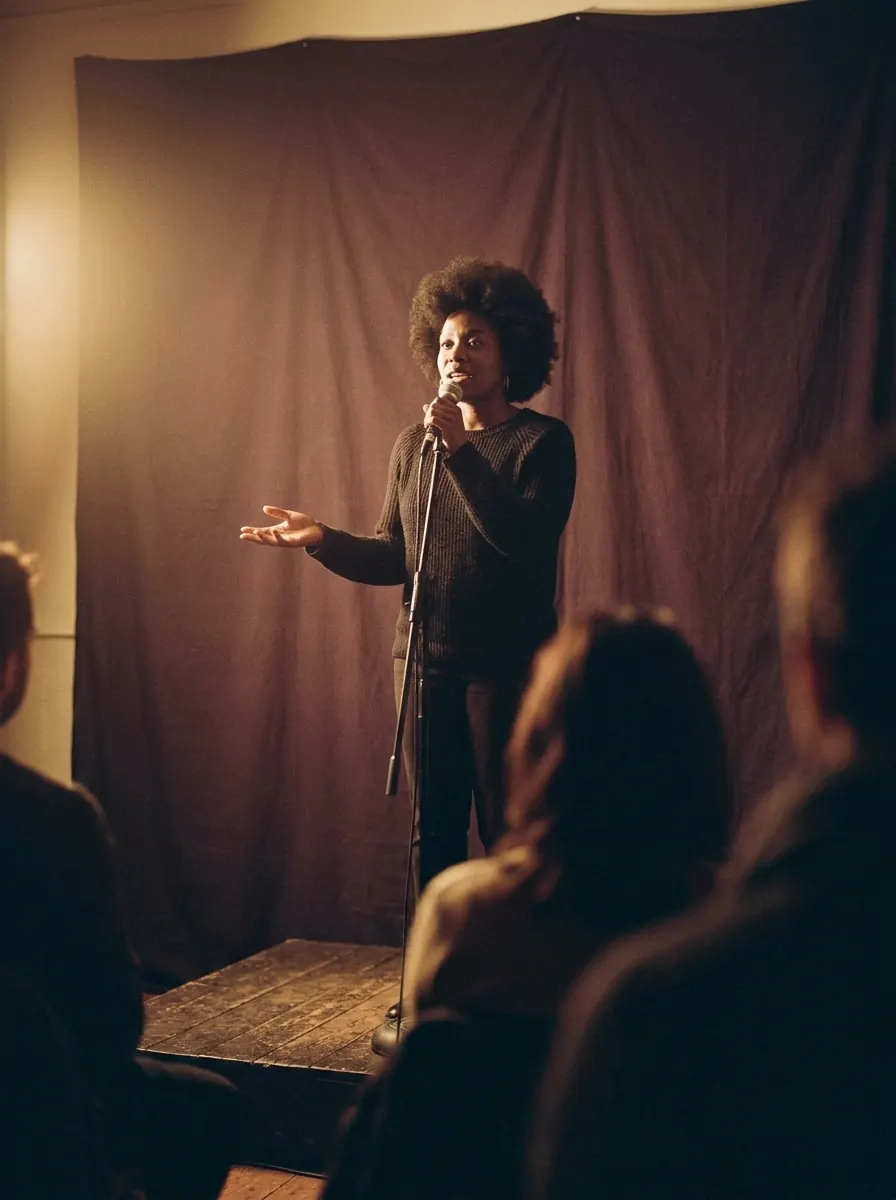
What the fear of public speaking is
Speech textbooks call it communication apprehension: fear or anxiety about real or anticipated communication with other people (Stand Up, Speak Out). Most people know it as stage fright. It is very common: one study opens with the line that about 77% of the general population fears public speaking (Heeren et al., 2013). Public speaking anxiety, the stronger form, is reported in 15% to 30% of the general population (Tejwani et al., 2016). Even experienced speakers feel some of it, so the goal is not zero nerves. The goal is nerves you can speak through.
What happens in your body
Common signs are shaking hands and legs, sweating, butterflies in the stomach, a dry mouth, a pounding heart and a quivering voice. They come from the fight-or-flight response: adrenaline rushes through your body and tells it to speed up its movements (Stand Up, Speak Out). The good news from the same textbook: audiences do not perceive the level of nervousness that speakers report feeling, and there is a good chance they won't notice unless you point it out.
How to get over fear of public speaking in five steps
None of these steps asks you to feel brave first. Each one lowers the fear a little, and together they are how to get over fear of public speaking without waiting for confidence to arrive on its own.
Prepare more than feels needed
Run the talk out loud in front of other people several times, spread over several days (Stand Up, Speak Out). Practice in conditions close to the real thing: standing, timed, with the notes you will actually use.
Swap perfect for realistic
Replace "this has to be flawless" with "small mistakes won't ruin my speech". If you slip, don't stop to correct it: keep going all the way through (Stand Up, Speak Out).
Breathe out slowly
Slow, deep breaths slow your heart rate (American School Counselor Association). AmberWillo's stage fright guide suggests a slightly longer exhale to trigger a calming response. See the 60-second routine before a talk.
Call it excitement
Trying to calm down is what most people do, but people who say "I am excited" out loud feel more excited and perform better than people who try to calm down (Brooks, 2014). The racing heart is the same; the label changes what you do with it.
Start small and repeat
Speak in low-stakes rooms first, then step up. A small online session on AmberWillo, free to start, is a gentle first room. The Managing Anxiety part of the practice plan lays out the order.
How to get over fear of public speaking for good
One good talk helps, but the fear only shrinks for good when speaking stops being rare. The NHS advice for anxiety is not to avoid the situations that make you anxious, and to build up the time you spend in them slowly instead. For speaking, that ladder can look like this:
- Week 1: answer one question out loud in a meeting or class.
- Week 2: give a two-minute update standing up.
- Week 3: present to a small group you know.
- Week 4: a short talk to people you don't know.
Keep each step until it feels boring, then move up. Avoiding a talk gives quick relief, but it also teaches your brain that the talk was dangerous, so the next one feels worse. If your hands or voice shake on the way up, read how to stop shaking when nervous. Working out how to get over fear of public speaking is mostly working out the next small step and taking it.
Guides in this section
- Calm your nerves in the 60 seconds before a talkA long-exhale breath, a grounding cue and a friendly face.
- How to stop shaking when nervousWhy you shake, what stops it fast and what makes it rarer.
When to get help
If fear makes you turn down work or classes, talk to a doctor or therapist. A meta-analysis found psychological interventions effective in reducing the fear of public speaking (Ebrahimi et al., 2019). Medication such as beta blockers is one option a doctor may discuss. Propranolol, for example, is used to help with symptoms of anxiety (NHS).
General information, not a diagnosis. If fear keeps you from work, school or daily life, talk to a doctor or a therapist.
Questions readers ask
How common is the fear of public speaking?
Very. One study puts it at about 77% of the general population (Heeren et al., 2013). Public speaking anxiety, the stronger form, is reported in 15% to 30% of people (Tejwani et al., 2016).
Can the audience see that I'm nervous?
Mostly no. Audiences do not perceive the level of nervousness speakers report feeling, and there's a good chance they won't notice unless you point it out (Stand Up, Speak Out). So skip the apology and start.
How long does it take to get over the fear?
There is no fixed number. What moves it is repetition: regular small talks, each a little harder than the last, instead of one big talk every few months.
What is the fastest way to calm nerves before a talk?
Breathe out slowly, longer than you breathe in, a few times. In a trial, five minutes a day of breathing with long exhales improved mood more than meditation did (Balban et al., 2023).
Practice where nobody is watching
A random prompt, 60 seconds and a private recording that shows if you rushed or said um. A low-stakes first rep.
Practise out loud for freeFree on iPhone and Android
Sources
- What Is Communication Apprehension?, Stand Up, Speak Out (Saylor Academy open textbook)
- Assessing public speaking fear with the short form of the Personal Report of Confidence as a Speaker scale (Heeren et al., Neuropsychiatric Disease and Treatment, 2013), PubMed Central
- Public Speaking Anxiety in Graduate Medical Education (Tejwani et al., Journal of Graduate Medical Education, 2016), PubMed Central
- Practicing for Successful Speech Delivery, Stand Up, Speak Out (Saylor Academy open textbook)
- Reducing Communication Apprehension, Stand Up, Speak Out (Saylor Academy open textbook)
- Coping With Student Anxiety, American School Counselor Association
- Get excited: reappraising pre-performance anxiety as excitement (Brooks, 2014), PubMed
- Anxiety, fear and panic, NHS
- Brief structured respiration practices enhance mood and reduce physiological arousal (Balban et al., Cell Reports Medicine, 2023), PubMed Central
- Psychological Interventions for the Fear of Public Speaking: A Meta-Analysis (Ebrahimi et al., Frontiers in Psychology, 2019), PubMed Central
- Propranolol, NHS
- How to Get Over Stage Fright: A Step-by-Step Guide, AmberWillo
- Online public speaking practice in small groups (1,851 people, 9,190 practice sessions), AmberWillo